Monarch Butterfly Migration Over Central Iowa
Fall 2007
By Robert D. Woodward
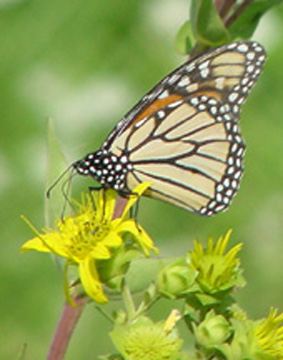
The date was August 11, the heat index was near 100, and a warm wind was blowing from the south at Neal Smith National Wildlife Refuge near Prairie City, Iowa. Five monarchs were observed nectaring on wildflowers in an area along the roadway leading into the refuge. The monarchs were a sign of things to come at the refuge where the butterflies soon will be migrating through the area on their way south to Mexico.
August 18--A return to Neal Smith National Wildlife Refuge turned up just two monarchs in an hour and one-half visit. This indicates the fall migration of monarchs has yet to start to move through the area. Back in Altoona, Iowa, in our butterfly garden, resident monarchs continued to enjoy their feeding on the many wildflowers.
August 21--A report in the Waterloo, Ontario, Record says dozens to hundreds of monarchs are gathering in the Canadian gardens and yards in the local area, readying for the long trip south.
August 31--Twenty-five monarchs were counted at Neal Smith National Wildlife Refuge during a visit of one hour.
September 1--The early phase of the fall migration of monarchs appears to be under way. Thirty-one monarchs were observed in the morning at Neal Smith National Wildlife Refuge. It's not clear to what extent the monarch movement has been slowed by extremely heavy rains in northern Iowa and southern Minnesota during the past two weeks.
September 2--Numerous varieties of wildflowers are blooming these days at Neal Smith National Wildlife Refuge, but the favorite now for monarch butterflies appears to be the tickseed sunflower. Twenty-five monarchs were counted during a morning visit, and most of them were noted in two areas of tickseeds that have proved to be choices of migrating monarchs during past autumns.

A monarch finds some nectar in a tickseed sunflower.
September 3--Ten monarchs were observed at Neal Smith refuge during a one-hour visit. A year ago at the refuge, 155 monarchs were counted on September 1 and 195 monarchs on September 2; rainfall slowed activity on September 3 of that year, but 61 monarchs were observed.
September 6--A morning visit to Neal Smith National Wildlife Refuge was cut short after 45 minutes when a light rain began to fall over the area. Before the rainfall began, a single monarch was noted flying over the prairie in the northern sector. Back home in our butterfly garden, no monarch activity was noted during the day. Many of the migrating monarchs still may be staying to the north. A TV photograph on WHO in Des Moines showed numerous monarchs resting on plants in Rolfe, Iowa, which is in the northwestern part of the state. On the national Journey North Web site, field reports from Tripoli in northeastern Iowa documented strong monarch activity there.
September 7--Heavy rains fell over central Iowa overnight with reports of 2 to 3 inches of rain being common, and in Altoona, where our butterfly garden is located, the rainfall was listed at 4.5 inches. A cold front passed through the state from the northwest, and this sped up the movement of migrating monarchs from the north. By early afternoon, 14 monarchs were counted in our butterfly garden. A visit to Neal Smith National Wildlife Refuge indicated new migratory movement, too, and in an hour and 15 minutes, 38 monarchs were counted. Late in the afternoon in our butterfly garden, a regular pattern existed as monarchs flew in from the north to nectar on goldenrod, phlox, and zinnias. In an hour, another 54 monarchs were observed. Along with 5 monarchs noted along the roadways, the day's total came to 111.

A monarch feeds on goldenrod in the butterfly garden.
September 8--This was a spectacular day for observing the migration of monarch butterflies. At Neal Smith National Wildlife Refuge, monarchs could be seen during the morning nectaring on tickseed sunflowers and purple asters, and in 3 1/2 hours, 275 monarchs were counted. The fall migration clearly was occurring. In the first two hours from 9 a.m. to 11 a.m., monarchs were counted at the rate of 100 an hour as they nectared at stop-off points in the northern part of the refuge. The large refuge sits in an area surrounded by Iowa farmland, so it provides a natural spot for the monarchs on their migration south. Late in the afternoon, back in our butterfly garden in Altoona, another 70 monarchs were counted as they flew in from the north to stop amid the many wildflowers.

The beauty of autumn: A migrating monarch visits the purple asters.
September 9--For the second consecutive day, migrating monarch butterflies were putting on a show at Neal Smith National Wildlife Refuge. During three hours of observations on Sunday morning, 403 monarchs were counted--mostly in the northern part of the refuge. For the most part, they were nectaring once again on tickseed sunflowers and New England purple asters. One-hundred monarchs were counted in the first half-hour beginning at 9 a.m. A strong breeze was blowing from the north northwest, and numerous monarchs were noted coming up out of the big bluestem grasses where they likely had spent the night. After feeding on the wildflowers, the monarchs could be seen riding the wind to the south--some floating, some racing, others traveling in pairs. Back home in our butterfly garden in the late afternoon, however, no movement of monarchs was noted after two days of heavy activity.
September 10--Rain began to fall about 5:30 a.m. and continued throughout the morning. The weather was cool, and no monarchs were observed during the day. Perhaps the heavy monarch activity over the past weekend signaled that the major butterfly movement was concluding through central Iowa. Cooler times are predicted for the days ahead.
September 11--A strong wind from the north northwest was blowing across the prairie at Neal Smith National Wildlife Refuge, hampering the movement of migrating monarch butterflies. Thirty-three monarchs were counted during two hours of observations in the morning. When strong winds are blowing, monarchs at Neal Smith often seek refuge near a savanna trail where the prairie meets the wooded areas. Many of the monarchs were found there on this day.
September 12--Sunny skies, temperatures in the 60s, and a calm day with minimal breeze provided a better environment for migrating monarchs than what existed in the past two days at Neal Smith National Wildlife Refuge. During 1 and 1/2 hours, 142 monarchs were observed. They were centering their nectaring activities on sawtooth sunflowers and New England purple asters, and on one hillside, they were flying to and fro in the afternoon sun while feeding on the sunflowers. In several spots where the asters are now flourishing, the monarchs feeding on the wildflowers created a beautiful scene.

Four monarch butterflies enjoy the natural beauty of a sunny afternoon.
September 13--During a six-hour trip to St. Louis, 50 monarchs were counted along the roadways in Iowa and Missouri. They appeared to be moving south.
September 16--Nineteen monarchs were counted in Missouri and Iowa during a return to Altoona.
September 18--In one hour of observations at Neal Smith National Wildlife Refuge, two monarchs were counted. The tickseed sunflowers, a popular wildflower for migrating monarchs on September 8 and 9, are now going to seed, and the yellow blossoms are disappearing.
September 19--A single monarch was observed in our butterfly garden in Altoona.
September 20--Fifteen monarchs were counted during a trip on a highway across the south side of Des Moines. The monarchs were flying higher these days than they had been earlier in the fall migration.
September 21--Five monarchs were observed at times during the day flying through our butterfly garden. The day was sunny, warm, and windy. The New England asters are finally beginning to bloom more fully. In past seasons, they have been a major attraction for migrating monarchs, but for several recent years, the monarch traffic and the blooming of asters in our garden have not conincided too well.
September 22--Some monarch activity continued at Neal Smith National Wildlife Refuge near Prairie City. Twenty-three monarchs were counted during two hours of observation in the morning. The day was clear and sunny with the morning temperature in the mid-50s. Most of the monarchs were nectaring on sawtooth sunflowers, which are a dominant wildflower on the prairie these days. Another 10 monarchs were observed along the roadways, and three monarchs visited our butterfly garden during the day.
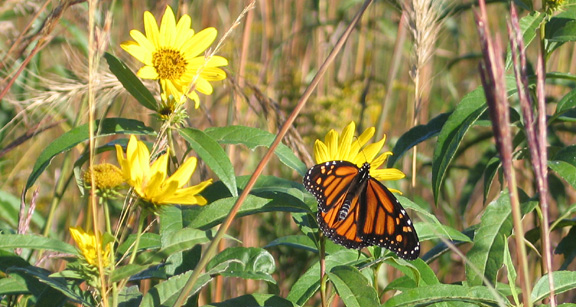
A new monarch nectars in the morning sun.
September 23--Monarch observation is often filled with surprises, and on this day, the monarch migration activity picked up again after several days in which the numbers moving through central Iowa appeared to be declining. During 2 1/2 hours of observations in the morning, 125 monarchs were counted at Neal Smith National Wildlife Refuge. At least 15 other monarchs were noted along the roadways and in our butterfly garden during the day. At Neal Smith, most of the monarchs were now turning their attention to sawtooth sunflowers as the source of nectar--even passing up the New England asters in full bloom these days.

Sawtooth sunflowers attract a migrating monarch butterfly.
September 24--In the late afternoon, a single monarch stopped on a New England aster in our front garden.
September 26--Ten monarchs were observed during the day--seven on the Drake University campus in Des Moines and three others along area roadways.
September 27--A single monarch was noted in our butterfly garden.
October 3--A monarch was observed flying across a busy roadway in Des Moines.
October 4--Taking advantage of a warm autumn morning, a new monarch was spotted stopping on a zinnia in our butterfly garden. It then flew into a nearby tree to flex its wings in the warm sunlight.
October 8--A monarch was observed flying across the Drake University campus at midday.
October 9--The morning sun was warming on a clear autumn day, and another monarch was noted in our butterfly garden. It was nectaring on a red geranium and then stopping off on a blue spruce to open its wings to the warm sunlight. Then, in the early afternoon, five or six monarchs were visiting our butterfly garden, where they were nectaring on zinnias and New England asters.

A monarch nectars amidst the colorful flowers of autumn.
October 22--A single monarch was noted on a flower in our butterfly garden during a sunny afternoon.
October 29--The last sighting of a monarch butterfly in the fall of 2007 was recorded. The monarch was noted over the noon hour on a blossom on a tree on the Drake University campus. It was the latest ever sighting of a monarch during a fall season.