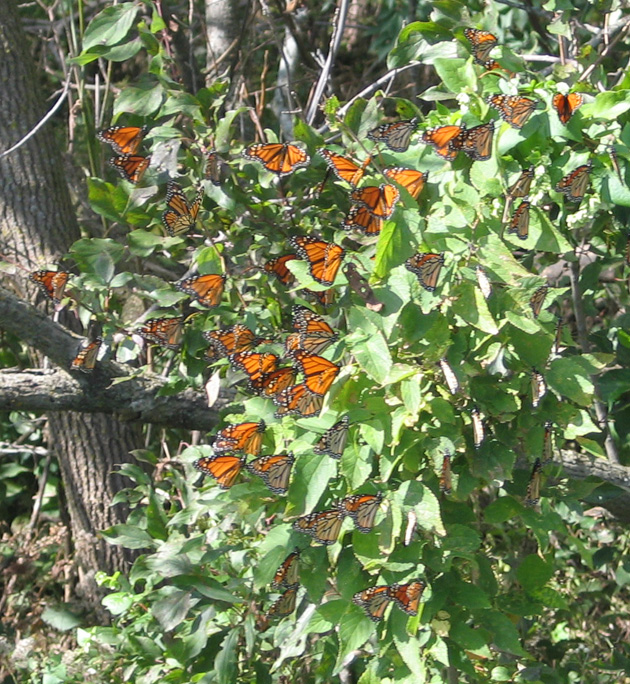
Monarch Butterflies Rest in Central Iowa on Their Way South in 2010
The fall migration of monarch butterflies is under way over central Iowa, and field observations are being carried out at Neal Smith National Wildlife Refuge to assess the movement. The first two monarch butterflies of spring 2011 were observed in our butterfly garden in central Iowa on May 12. The two monarchs showed up earlier than ones in previous years. Monarch activity continued in our garden throughout the summer. The first monarch of the 2010 season was spotted in the garden on May 23. In two previous years, the first monarchs were noted here on May 19 in 2009 and May 21 in 2008. Five monarchs were around the garden on May 23 of this year, and two were noted May 24. During July and August, monarch activity was observed nearly every day. Monarchs continued to come into the garden during the fall migration time. This "Save the Monarch" site is devoted to documenting the monarch movements in spring, summer, and fall across central Iowa. Check the reports for the fall 2009 migration, fall 2010 and fall 2011. See the fall 2008 migration reports for details on the day-by-day movements south. Field observations have been carried out in central Iowa for 14 years to determine the monarch migration activity and how it fits into the bigger story of the yearly monarch migrations across the country. In three recent summers, field research also studied monarch activities in central Iowa. For more information on the monarchs' movement north in the springtime and south in autumn, visit the superb site of Journey North, where you will find daily reports and weekly updates of the movements north and south. The fall 2010 migration of monarch butterflies in central Iowa was loaded with activity. A late arrival on September 24 provided a wonderful scene for monarch observers.Visits to Neal Smith National Wildlife Refuge indicated significant movement of the monarchs as they made their way south. September 4 was a pivotal day in the observations of the first larger numbers of the monarchs, and a week later, monarchs were being noted in record-setting numbers. On September 11, the count was 3,085 monarchs. The migration appeared to be ending, but more than 1,000 monarchs provided a beautiful surprise on September 24. The last of the migrating monarchs were seen at Neal Smith September 30. The first 2010 monarchs were observed visiting various spring flowers in our garden in the early days. One was nectaring on a Dame's Rocket. On Sunday, June 6, another was noted nectaring on the flowers of one of our catalpa trees. In July and August, monarchs were seen daily in our garden, and overall butterfly activity was strong. As noted elsewhere in the country, red admirals seemed to be more prolific in 2010; they certainly were in our garden. In our butterfly garden in Altoona in central Iowa, the first monarch of spring 2009 was observed on Tuesday, May 19. It was flying in and out of the garden. In 2008, the first monarch was seen in our garden on May 21. Judging from the 2010 date of first sighting as May 23, the monarchs' arrival in this area had been fairly consistent--but not in 2011. After observation of the first monarch of the spring in 2008, monarch activity continued in June and July, slacked off for a bit, then became strong during the first two weeks of August. Five or more monarchs could be seen nearly every day flying around the garden in early August. This pattern continued for the most part in the spring/summer of 2009. Monarch activity also was strong throughout the summer months of 2007 in our butterfly garden, indicating a healthy population. Five or more monarchs were noted daily in June, July, and August. In early June, monarchs were observed layng eggs on the milkweed plants in the garden, and a common summer sight was two or three monarchs chasing each other over the wildflowers. In the summer of 2008, monarchs were seen laying eggs on the milkweeds in our garden, and daily sightings were occurring in early July. The first monarch of the spring 2007 was observed in our butterfly garden on May 12, 2007. The next day the second monarch was noted. And the monarch activity in our garden was the heaviest that year in a number of summers. The milkweeds, host plant for the monarchs, are abundant in our garden, and they provide plenty of possibilities for monarchs to lay their eggs. Turning to the fall 2008 migration, on Friday, September 5, nearly 300 monarchs were observed at Neal Smith National Wildlife Refuge near Prairie City, Iowa, and in our butterfly garden in Altoona, Iowa. The monarchs were a welcome surprise as the fall movement of migrating monarchs had been limited judging from observations in late August and early September at Neal Smith refuge and in our butterfly garden. But by mid-September, migrating monarchs were being seen in significant numbers at the refuge, and observations on two days turned up counts of 1240 and 1002 monarchs--a surprising strong number compared with previous years. Observing monarchs is a great way to study our natural surroundings. They can be found across the United States. In late June 2007, for example, I observed a monarch flying north along Nauset Light Beach on Cape Cod--a special sighting in that the butterfly was just miles from where Henry Beston wrote his nature classic, "The Outermost House." At that time, Beston noted the passing of monarchs making their way south in the fall migration. The butterfly I observed in 2007 was at the most eastern point in the continental United States! Again in June 2008, I saw a single monarch flying along the Atlantic Ocean shore in the same area. Important News: Neal Smith Named as One of 13 Protected Areas for Monarch Butterflies Officials in Mexico, the United States, and Canada have formed a Trilateral Monarch Butterfly Sister Protected Area Network to share information and to work for ways to save the monarch butterfly. Neal Smith National Wildlife Refuge in Iowa is one of 13 preserves to be identified as protected areas in the three nations. Details of the network were worked out earlier in 2006 during meetings in Mexico and California, and international agreements will be signed to carry out the plan. See a listing of the 13 areas.
This "Save the Monarch" site also includes field reports on the monarchs as they passed through central Iowa in fall 2005. Go also to the fall 2004 reports on the Iowa migration. This is the 14th year of these reports. To compare the migration days in various years, you can study other reports for the years 1997, 1998, 1999, 2000, 2001, 2002, and 2003. See also the Monarch Monitoring Project at Cape May, N.J. Careful field observations over the past years provide some interesting details concerning the migration of monarchs over central Iowa each autumn. The peak migration days changed somewhat between 1997 and 2005--a period of nine autumns of migration. During that time, the migrations have been observed in our butterfly garden in Altoona, Iowa; at Chichaqua Bottoms wildlife area in northeast Polk County, and at the Neal Smith National Wildlife Refuge near Prairie City, Iowa. Judging from the field observations, the peak day of migration in 1997 was Friday, September 19. In 1998, the peak days were Wednesday, September 16, and Thursday, September 17. In 1999, the peak day was Saturday, September 11. Peak days in 2000 were Sunday, September 10, and Monday, September 11. In the autumn of 2001, the peak day was the earliest during the five years--on Saturday, September 8. In 2002, the peak days were Friday, September 13, and Saturday, September 14. In autumn 2003, the peak migration days fell on Sunday, September 14, and Monday, September 15--nearly paralleling the days of 2002. A heavy migration count also was noted on Saturday, September 6, 2003. In 2004, the peak day was registered much later on Wednesday, September 22. In 2005, the peak day was Thursday, September 8. Beautiful Word Picture Tells of 2003 Migration Over Lake Michigan On Tuesday, September 9, 2003, this field report came in to the "Save the Monarch" Web site from an observer in southwest Michigan: "Tonight, about an hour before sundown, I was boating on Lake Michigan near the eastern shoreline just south of St. Joseph, Michigan. I was about 1/2 mile offshore. There were hundreds of monarch butterflies headed south. My wife and I observed a constant flow of them for over a half hour. They were flying, I would say, 75 to 200 feet up. Wind was very light--about 3 to 5 knots out of the north, and the butterflies were all headed south...They would fly upward, then soar a long time on the air currents. Some would spiral upward--head high--but facing into the wind. We actually followed some of them in our boat for at least a half mile with them flying in this attitude...I have lived in Michigan for over 20 years and boated on Lake Michigan the same amount of time, but I have never seen this many monarch butterflies at once--it was fantastic."--From John Steves, St. Joseph, Mich. Think of the beauty on the land and how monarch butterflies contribute to it. Think of a land where there would be no more monarchs. Could that happen? Some experts think it could. Why not join in the call to save the monarchs before they disappear forever? Monarchs represent the natural beauty of the universe and a continuity in life. Their fall migration is a beauty to behold; their arrival in the spring is a confirmation of continuity.  The Internet represents a perfect place to tell their story and to link people with the common interest of saving them for all times. This site was established to provide resources for learning more about monarchs; to provide links to other Internet sites that are tracking the progress of them; and to include my observations of more than 30 years of writing, photographing, and thinking about them. The photograph at the top was taken in the summer 2006 at Neal Smith National Wildlife Refuge near Prairie City, Iowa. My home is east of Des Moines, Iowa, in Altoona, where we have an extensive butterfly garden. Visit the new Digital Nature Art Gallery to view original photographs redesigned using the computer. See also Gallery No. 2. Monarch butterfly activity was considerable in late July and August in central Iowa. In our butterfly garden, it was common every day to see 5 to 10 or more monarchs feeding on the flowers. See one group of three. Check out the fall 2001 migration reports on this site (Fall Migration 2001). For the best overall picture of monarch migration in America and Mexico, go to the Journey South Web site for weekly migration updates beginning Aug. 30, 2001. And note movements of the monarchs across the nation by going to Journey North/South Web site, the 2001 Monarch Monitoring Project at Cape May Point, N.J., and the Chincoteague Monarch Monitoring Project at Chincoteague National Wildlife Refuge, Assateague Island, Virginia. Summer 2001 Monarch Activity Monarch activity picked up in our butterfly garden in late July 2001. On Tuesday, July 24, four monarchs were spotted feeding on the prairie coneflowers and phlox. On Thursday, July 26, at least a half dozen monarchs were spending time in the front garden. See one monarch visitor. On Sunday, July 29, 45 to 50 monarchs were observed along the roadways in central Iowa and in our butterfly garden--where 10 monarchs were putting on a show flying in and out of the garden. |
|
|
Other ContentsMonarchs in the News
|
|
|
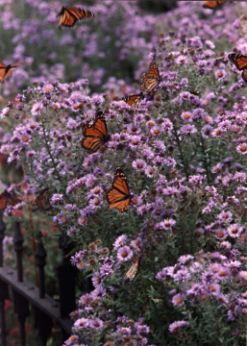
The first strong indication that the fall migration of monarch butterflies was under way in central Iowa came on August 28. In the late afternoon, migrating monarchs could be seen flying over the highways in the area and in our butterfly garden. The next day, unseasonably hot weather set in for several days in the area, and the migration appeared to slow down. But by Friday, September 8, much heavier monarch activity was observed, and on Sunday and Monday, September 10-11, the monarchs were seen in large numbers. Reports on the migration can be found here throughout autumn (Fall Migration 2000). Nationally, an excellent Annenberg Foundation and CPB site is providing weekly updates on the migration of monarchs and other wildlife (Journey North/Journey South). On the site, see specific details on how a major cold front affected the movement of migrating monarchs through Iowa. Fall 1999 Monarch MigrationOn Labor Day, Monday, September 6, the monarch activity picked up considerably in our butterfly garden and across the roadways of central Iowa. Cooler weather to the north in Minnesota, Wisconsin, North Dakota and South Dakota was pushing the monarchs on the way south. The cooler weather continued throughout the week, and numerous monarchs were sighted in central Iowa.Watch here for the latest details of the 1999 migration (Fall Migration 1999)Spring 1999 Monarch ActivityOn Monday, May 10, two monarchs were spotted in central Iowa--the first of the season. By the week of May 17-21, single monarchs were regularly visiting our butterfly garden and searching out the early flowers. The following week--on Wednesday, May 26--monarch activity picked up considerably. At least 10 monarchs were in the butterfly garden during the day, and numerous monarchs were seen along the roadways in central Iowa. Nationally, the Annenberg and CPB site continues its excellent reporting on monarch migrations. Visit Journey North for weekly details on the Spring 1999 migration.Autumn 1998 MigrationIn mid-August in central Iowa, the purple New England asters were beginning to bloom, and some monarch butterflies were stirring, hinting that the migration time was not far away. Keep a watch here for the latest details of the migration (Fall Migration 1998). Check the Annenberg and CPB site for its continuing reports on the migration of monarchs (Journey South 1998). Visit the Monarch Monitoring Project at Cape May Point, New Jersey (Report from Cape May Point). Note what the naturalist Henry Beston wrote about monarch migrations in times past (Beston's observations).Spring 1998 Monarch ActivityThe first monarchs of the spring in central Iowa were seen in the final days of May 1998, and in our butterfly garden, the first two monarch caterpillars were found on milkweed leaves on Friday, June 5. The two caterpillars were approximately one-quarter inch in length when first discovered. Nationally, the 1998 northward migration of monarchs was documented by Journey North News. See the superb site Journey North for information on the spring migration of monarchs. Beginning Feb. 10, 1998, and running through late spring, the site--an Annenberg and CPB science and math project--posted weekly migration updates each Tuesday. Check the site, too, for the spring 1997 monarch migration details.
Autumn 1997 MigrationThe autumn 1997 migration of monarch butterflies across central Iowa appeared to reach its peak on Friday, Sept. 19, 1997. In central Iowa, the monarch activity began increasing in late July 1997, and by mid-August, the monarchs appeared to be readying for the migration south. After years of observing monarchs in our butterfly garden, I've come to recognize the day-by-day increase in monarch activity as the migration time nears. Check here for details on the migration of the monarchs through central Iowa and beyond. (Fall Migration 1997) The Los Angeles Times reported on Sept. 11,1997, that the autumn 1997 migration might be at least 150 million butterflies. Check the Annenberg and CPB site for excellent field reports on the monarchs' southerly migration in 1997. (Journey South)
| |
 |
Why Not a State Insect?
|
 |
The Asters of Autumn
|
|
|
|

Monarch's ChildBy Robert D. Woodwardcopyright 1980 I must be the child of a cottonwood tree, blowing forever in the wind, I must be the child of a monarch butterfly, soaring forever off in time. I must be a part of cloudy, windy days, whipping and churning on the land, I must be a part of the earth and the sky, for out there, I feel as one. Chorus: Time it has no beginning, Time it has no end, Life seems to go on forever, If only for a monarch on the wind. |
 |
|
I must be a child of the straightest of oaks, putting down roots for all time, I must be a child of the swallow up on high, dipping and soaring in the wind. I must be child of the wildest of flowers, coming back again and again, I must be a part of the earth and the sky, for out there, I feel as one. Chorus: Time it has no beginning, Time it has no end, Life seems to go on forever, If only for a monarch on the wind. |
 |
|
|
|
|
Save the Milkweed, Save the Monarch
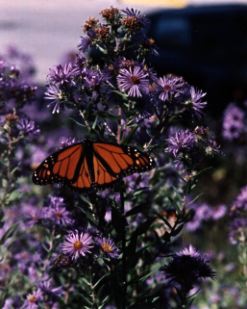
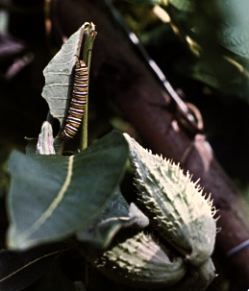
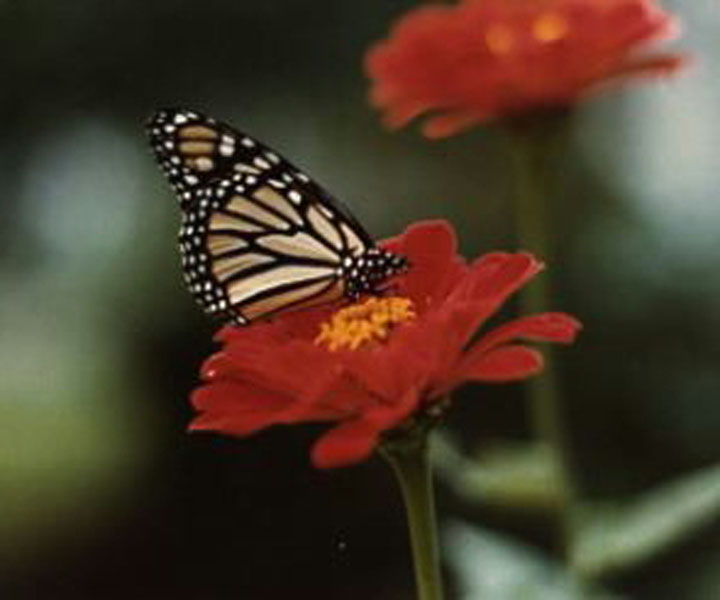
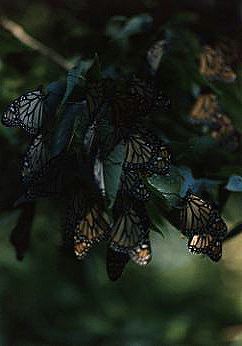
In Iowa--as in other agricultural areas around the world--a contradiction exists: Milkweeds are the host plants for monarch caterpillars, and milkweeds are considered to be a farmer's enemy. We grow milkweeds in our butterfly garden to provide for the monarchs, and every summer we find numerous caterpillars that end up as beautiful monarchs. The monarch caterpillar in one of the smaller photographs is on a Common Milkweed. Plant a milkweed or two, save the monarch. Plant a Flower, Save the MonarchAmong the best flowers for attracting monarchs in summertime are purple coneflowers (right), black-eyed susans, cosmos, zinnias, phlox, daylilies, liatris, and the butterfly milkweeds. But the more varieties of flowers you plant, the more likely you are to attract monarchs and other species of butterflies. In autumn as migration time comes, the asters--purple, pink, red and yellow--are all important ones to have in your garden. And the butterfly bushes are especially appealing to monarchs. We find that sunflowers and Indian cup plants also attract them.(See Butterfly Garden Under Construction) Plant a Tree, Save the MonarchThe migrating monarchs especially like places to roost overnight. In our garden, they have used oaks, hackberries, ashes, and apple trees as resting places. It's a beautiful sight to see a hundred monarchs on the branches of an oak tree in the dying light of an autumn day. |
|
 |
Monarch Resources
|
Monarch Links on the Internet
Digital nature art can be viewed by going to the Digital Nature Art Gallery.
|
|
Save an Image, Save the Monarch |
|

Revised: October 8, 2011
Copyright 1997 Robert D. Woodward
Robert.Woodward@drake.edu
Drake University