Skip Sub Menu


Claire Hruby
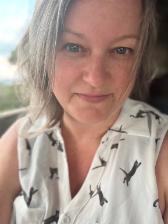 Assistant Professor of Environmental Science and Sustainability
Office Location: 116 Olin Hall
515-271-3774
claire.hruby@drake.edu
Hruby CV
Claire Hruby has a diverse background in geology and environmental science. She received a B.A. from Wesleyan University in Connecticut, where she studied magma genesis of volcanoes in the Aegean Arc, Greece. She received a Masters of Science from Iowa State University’s Department of Geological and Atmospheric Science, where she studied geophysics. Claire taught geology as an adjunct instructor at both Drake and Grinnell College in 2002 and 2003. In 2003 she joined the Iowa Department of Natural Resources (DNR) as a geologist, working on assessment of risks to water resources from animal feeding operations and waste storage structures. In 2010, she returned part-time to Iowa State University as a doctoral student in the Environmental Science Graduate Program. Her Ph.D. research was on the fate and transport of nutrients and bacteria from poultry manure application on corn. While working at Iowa State, she also taught a course on the Impacts of Agriculture on Water Quality. After receiving her degree, she remained at Iowa DNR until 2023, working on mapping, supporting river restoration and stream mitigation planning, coordinating the ambient groundwater monitoring program, testing for pathogens at beaches, and conducting statewide PFAS testing at public water supplies.
Since joining Drake’s Environmental Science and Sustainability Department in 2023, Dr. Hruby has taught courses in geology, hydrology, soil and water monitoring, water resources, biogeochemical cycles, and first-year seminars on volcanoes and water. Claire has also started a research program that works to better understand the sources and impacts of contamination in soil and water across the state. Students who are part of her Soil and Water Assessment Team work on projects in all four corners of the state, and several in Polk County and the Des Moines metro area.
The goal of many of these projects is to identify sources of fecal contamination in recreational waters. To do this, students measure E. coli concentrations and then take DNA samples from the water to determine which organisms are contributing. Other projects use DNA sampling to identify which organisms are present in an area, including fish, macroinvertebrates, and amphibians. Her team has also worked on projects related to heavy metals in soils, PFAS (“forever chemicals”), nutrients in rivers and lakes, and cyanobacteria blooms. Drake was recently awarded a Roy J. Carver Charitable Trust grant to upgrade Dr. Hruby’s Water Quality Lab, which will allow her to accommodate more students and teach them to do more of the analyses, themselves.
Another topic of her research is hydrology, which involves measuring how water moves on the landscape. This is especially important for evaluating efforts to protect groundwater resources. To do this, her team installs water depth and water flow sensors, collects precipitation data, and uses geographical information systems (GIS) tools to quantify water as it moves through a system.
A&S News

January 15, 2026
November 25, 2025
A&S Calendar