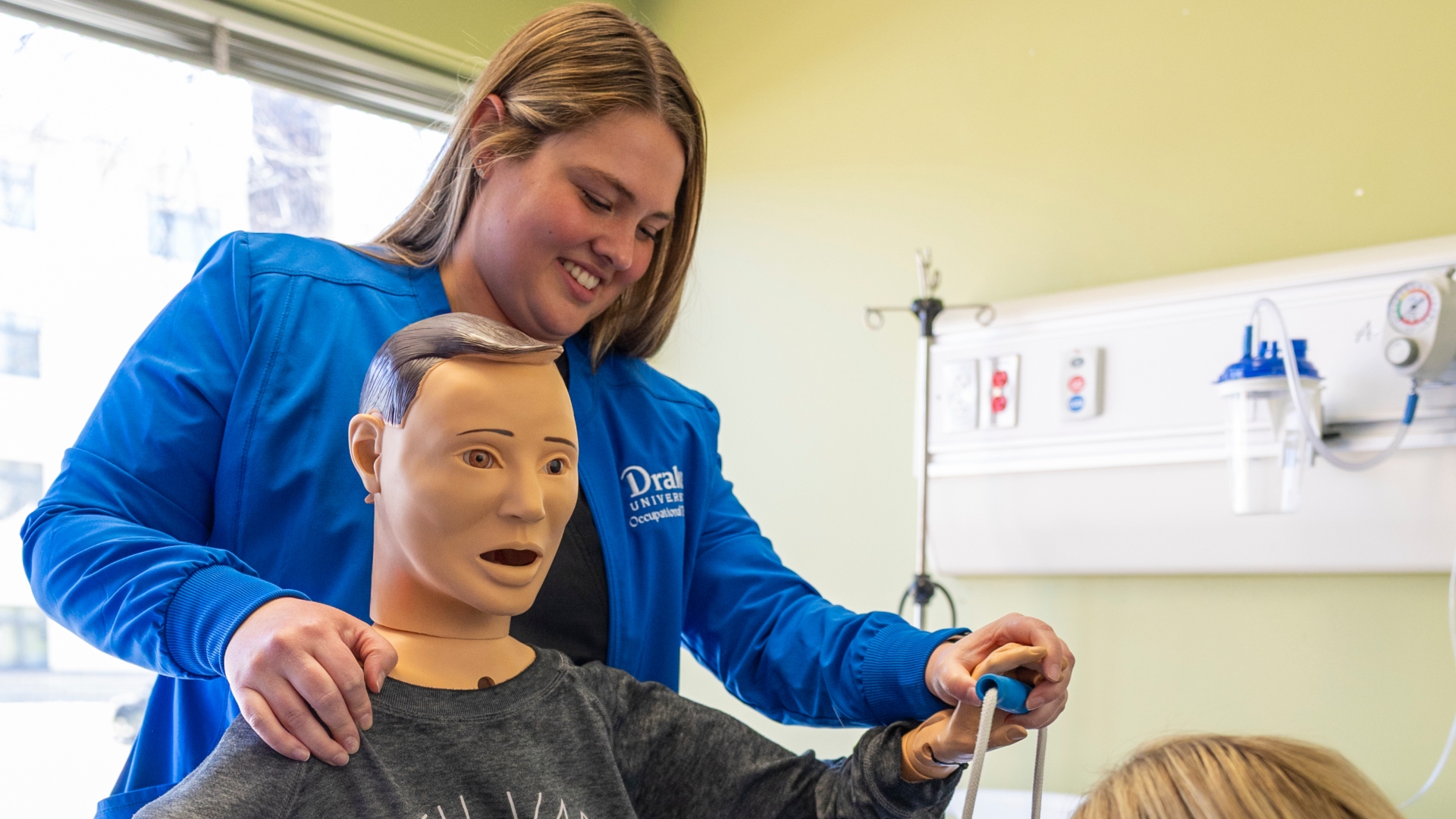
Occupational Therapy Doctorate Admission
Admission to the Drake University OTD program is based on academic and personal qualifications that are necessary for successful, competent practice as an occupational therapist.
Occupational Therapy Doctorate Admission
Candidates are evaluated on the basis of the fit between their personal goals and the mission and goals of the OTD program. Prior education, work experience, honors, awards, service to others, and leadership activities are also considered in the admission process. Prior shadowing in an occupational therapy setting is helpful, but not required.
Jump to
Admission Requirements
Applicants must satisfy these requirements for applications to be eligible for consideration for the Occupational Therapy Doctorate Program. Please note: fulfillment of these criteria does not ensure admission.
- Complete the Drake Curriculum Areas of Inquiry (AOI) requirements prior to entering the OTD program. Students who have earned one of the following degrees will be waived from the Drake Curriculum AOI requirements:
- Associate of Arts (A.A.) degree from a community college in Iowa, Illinois, Minnesota, or Missouri
- Associate of Science (A.S.) degree from a community college in Iowa
- Bachelor's degree from a regionally accredited college or university
- Complete at least 3 years of undergraduate coursework (92 credit hours).
- Earn a cumulative GPA of 3.0 or higher (as calculated in OTCAS).
- Complete (or be in the process of completing) the prerequisite coursework outlined in the table below.
Ready to apply?
Submit an application through the Centralized Application Service for Occupational Therapy (OTCAS).
Prerequisite Coursework
All required courses must be completed by the end of the summer term prior to entering the OTD program.
| Subject | Courses/Credit Hours | Drake Courses |
|---|---|---|
| Anatomy and Physiology A complete year course sequence in anatomy (one semester) and physiology (one semester) is required. Students may take a combined anatomy/physiology sequence, but they must take both semesters in order to fulfill the requirement. Labs are required. |
2 courses/8 credit hours (including labs) | HSCI 125/L and 141/L (PHAR 125 may replace HSCI 125); or BIO 018/L and 129 |
| General Psychology A one-semester introductory course in psychology is required. This course must fulfill the prerequisite to allow students to take courses in developmental and abnormal psychology. A lab is not required. |
1 course/3 credit hours | PSY 001 (4 credit hours) |
| Developmental Psychology Students may take a one-semester course in child and adolescent development, adult development and aging, or lifespan development. A lab is not required. |
1 course/3 credit hours | HSCI 146 or PSY 041, 042 or 044 |
| Abnormal Psychology A one-semester course in abnormal psychology is required. A lab is not required. |
1 course/3 credit hours | PSY 076 |
| Social Sciences Elective A one-semester social science elective course is required. Courses may be taken in economics, sociology, psychology or other approved social science areas. |
1 course/3 credit hours | Approved courses in ECON, PSY, SCS and other social science departments |
| Statistics A one-semester course in general statistics is required. Business statistics, psychology statistics or biological science statistics courses are accepted. |
1 course/3 credit hours | HSCI 060, BIO 140, or PSY 011 |
| Medical Terminology A one-semester course in medical terminology is required. |
1 course/1 credit hour | HSCI 095 |
| English Composition A complete year course sequence in college-level English writing or composition is required. The sequence can be made up of a one-semester college-level composition course and a one-semester intensive writing course. |
2 courses/6 credit hours | FYS and Written Communication AOI |
| Public Speaking A one-semester course focused on public speaking is required. Students may submit non-public speaking courses for syllabus review if the course contains a robust classroom presentation component. Interpersonal communication courses will NOT be accepted. |
1 course/3 credit hours | ENG 063 |
| General Electives 59 semester credit hours in general electives are required; Drake requires students to complete a minimum of 3 years of undergraduate coursework (at least 92 credit hours). |
59 credit hours | Drake Curriculum Areas of Inquiry |
Students must earn a grade of C or higher in order to fulfill prerequisite courses. Students who wish to fulfill prerequisites using Advanced Placement (AP) scores must earn a 4 or higher on the AP exam. Students may transfer in a cumulative maximum of 66 credit hours from all 2-year institutions they have attended. Please see Drake University's Transfer Credit or contact the College of Pharmacy and Health Sciences at (515) 271-3018 for more information.
Pre-Occupational Therapy Admission
To apply for the Drake Direct OTD program, you must complete a Drake University undergraduate application.
Drake Direct 3+3 OTD Program
Drake Pre-Occupational Therapy students have a guaranteed seat in the professional OTD program provided that the above admission requirements are met.
Transfer Student Admission
Transfer students are welcome to apply for admission to pre-OT. In order to be considered for transfer admission into pre-OT, students must meet the requirements for entrance into the professional OTD program at the time of admission into pre-OT, with the exception of having all the prerequisite coursework completed.
Transferring into pre-OT at Drake does not guarantee admission into the professional OTD program. Students who are not admitted into the professional program are advised on other degree options and career pathways within the College of Pharmacy and Health Sciences and at Drake.
2026-27 Occupational Therapy Doctorate Tuition & Costs
All admitted OTD students receive the Pursuit of Excellence in Occupational Therapy Scholarship. The specific amount awarded can be found in your admission letter. Students are encouraged to complete and submit their application early in the admission cycle to maximize financial aid awards. Grants and other forms of financial aid may be available to students. Details on these awards will be provided to admitted students who have completed a FAFSA early in 2027 by our financial aid office. There are also a number of other scholarships offered by organizations outside of Drake which OTD students may choose to apply for.
Questions about scholarships can be directed to the CPHS Assistant Dean of Enrollment Services, Dr. Nate Newman, at nathan.newman@drake.edu. Questions about federal loans, grants, and other forms of aid should be directed to the Financial Aid Office at financialaid@drake.edu.
Students entering the OTD program in Fall 2026 should complete year 3 by Spring 2029.
- Year 1: Fall 2026, Spring 2027, and Summer 2027
- Year 2: Fall 2027 and Spring 2028
- Year 3: Summer 2028, Fall 2028, and Spring 2029
| Term | Rate |
|---|---|
| Fall and Spring Full-Time | $20,452 (per semester) |
| Part-Time (less than 12 credit hours per semester) | $1,000 (per credit hour) |
| Summer - OTD Year 1 | $20,452 (per semester) |
| Summer - OTD Year 2 | $20,452 (per semester) |
Experiential Education Related Expenses
Students will complete fieldwork experiences and a doctoral capstone, which require onboarding steps such as CPR training, immunizations, and a physical exam; associated costs will vary. Some placements may occur outside the Des Moines metro area, resulting in additional travel or living expenses. Students are responsible for arranging and covering all related costs.
OTD Cost of Attendance Budgets
| Current Cost | Year 1 | Year 2 | Year 3 | Total Cost (3-year 2025-2028) |
|---|---|---|---|---|
| Tuition | $40,904 | $61,356 | $61,356 | $163,616 |
| Fees | $390 | $390 | $250 | $1,030 |
| Books/Supplies | $1,000 | $1,000 | $100 | $2,100 |
| Housing | $9,239 | $11,292 | $12,318 | $32,849 |
| Food | $3,600 | $4,400 | $4,800 | $12,800 |
| Transportation | $2,682 | $3,278 | $3,576 | $9,536 |
| Personal | $3,402 | $4,158 | $4,536 | $12,096 |
| Loan Fees | $1,014 | $2,348 | $2,348 | $5,710 |
| Licensure Costs | $ - | $ - | $515 | $515 |
| Total | $62,231 | $88,222 | $89,799 | $240,252 |
| Current Cost | Year 1 | Year 2 | Year 3 | Total Cost (3-year 2025-2028) |
|---|---|---|---|---|
| Tuition | $40,904 | $61,356 | $61,356 | $163,616 |
| Fees | $390 | $390 | $250 | $1,030 |
| Books/Supplies | $1,000 | $1,000 | $100 | $2,100 |
| Housing | $4,617 | $5,643 | $6,156 | $16,416 |
| Food | $2,160 | $2,640 | $2,880 | $7,680 |
| Transportation | $2,682 | $3,278 | $3,576 | $9,536 |
| Personal | $3,402 | $4,158 | $4,536 | $12,096 |
| Loan Fees | $1,014 | $2,348 | $2,348 | $5,710 |
| Licensure Costs | $ - | $ - | $515 | $515 |
| Total | $56,169 | $80,813 | $81,717 | $218,699 |
*Tuition and fees listed in the tables above are subject to change. According to FAFSA (Free Application for Federal Student Aid), cost of attendance is defined as total amount of attending the program, which includes tuition and fees, books, supplies, transportation, and loan fees.
More information about Drake University Cost of Attendance Budgets.
Technical Standards
The following technical standards describe non-academic qualifications considered essential for successful completion of the educational objectives of the OTD curriculum. Candidates and students must possess the ability to perform or ability to learn to perform the non-academic skills listed below.
Candidates and students must have the ability to:
- Acquire information presented through demonstrations, experiments, and exercises.
- Evaluate a patient accurately at a distance and close at hand to assess relevant health, behavioral, and medical information.
- Obtain and correctly interpret information through patient assessment and evaluation.
- Obtain and interpret patient information via electronic health records while maintaining patient confidentiality.
Candidates and students must have the ability to:
- Communicate interactively with patients to elicit information.
- Interpret nonverbal communication displayed by patients.
- Communicate effectively and sensitively to enable effective patient care including verbal, written and nonverbal communication.
- Communicate effectively and efficiently with all members of the health care team.
- Clearly and accurately record information necessary to document patient health care.
Candidates and students must have the ability to:
- Perform physical examination and assessment.
- Perform diagnostic and therapeutic maneuvers to provide patient care.
- Respond to emergency situations in a timely manner.
- Follow universal precaution procedures and applicable safety standards for the environment.
Candidates and students must have the ability to:
- Consistently, quickly, and accurately integrate information received.
- Integrate, analyze, synthesize, and interpret data in order to make decisions in clinical settings where there may be distractions.
- Perform clinical functions in a timely manner and under a high amount of stress in diverse clinical settings and patient populations.
- Perform clinical functions where others may be present.
- Perform basic mathematical functions and read and interpret information in an accurate and timely manner
- Integrate and process information promptly and accurately in a time-sensitive environment.
- Process information to solve problems, make decisions quickly, and respond immediately when necessary.
- Interpret causal connections and make accurate, fact-based conclusions based on available data and information.
- Formulate a hypothesis and investigate potential answers and outcomes to reach appropriate and accurate conclusions.
Candidates and students must have the ability to:
- Exercise good judgment.
- Promptly complete all responsibilities.
- Develop mature, sensitive, and effective relationships with patients and others (team members, families, caregivers, etc.).
- Effectively handle and manage heavy workloads and function effectively in stressful situations.
- Adapt to changing environments and display flexibility
- Function in the face of uncertainties inherent in patient care.
- Demonstrate compassion, integrity, concern for others, interpersonal skills, interest, and motivation.
- Accept feedback and respect boundaries.
- Care for all patients in an effective and respectful manner regardless of any protected status.
- Understand and function within the legal and ethical aspects of the practice of Occupational Therapy.
- Display ethical and moral behaviors commensurate with the role of an Occupational Therapist in all interactions.