The Honors Program Track
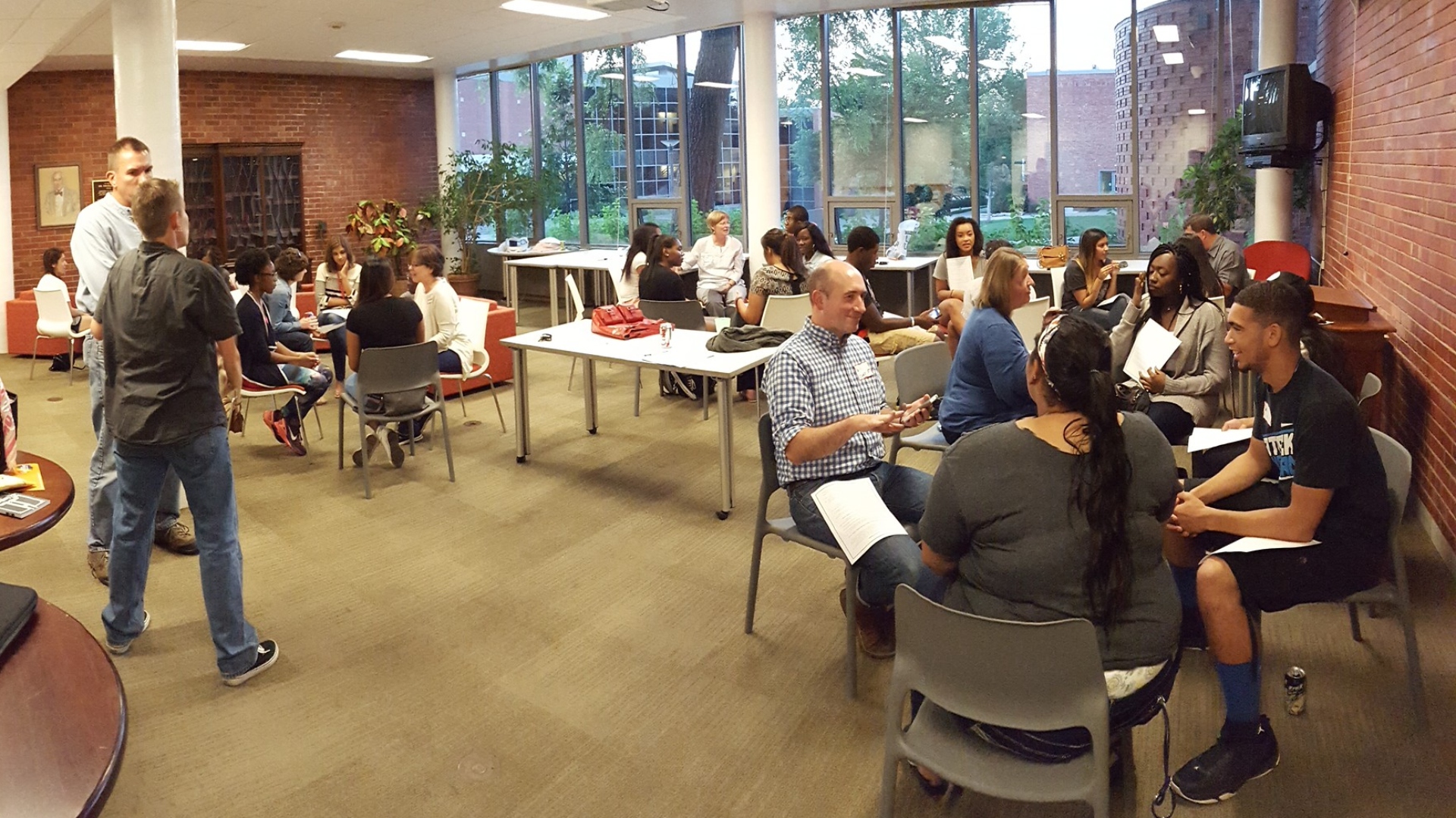
The Honors Program is more than just a curriculum. As a member of the program, you are part of a special community that fosters a dynamic, supportive, and social environment.
The Honors Program Track
The Honors Program Track provides an alternate option to the AOI track and is open to students of any major. Students are also welcome to take Honors courses, even if they are not completing the Honors Program Track, although preference may be given to Honors students during course registration.
The Honors Program Track offers more in-depth, interdisciplinary coursework. Often, two or more categories from the AOI track are combined to make one Honors course. The Honors Program Track is a tight-knit learning community of other curious students who are highly motivated. Honors students also sponsor and enjoy special programming and events outside of the classroom.
Honors courses are limited to 20 or fewer students. Small class sizes enable deeper discussions to strengthen writing and critical thinking skills. Students completing the Honors track will take one class each from the Artistic Literacy, Scientific Literacy, and Quantitative Literacy categories of the AOI track, along with the Honors-specific course Paths to Knowledge, and five Honors courses to fully replace the AOI track.
Honors Program Track Requirements
To replace Drake's AOI track requirements, students must apply and be accepted into the Honors Program Track—in addition to applying and being accepted to Drake University—complete a course in Artistic Literacy, Quantitative Literacy, Scientific Literacy, Paths to Knowledge, and 5 additional Honors electives. Optionally, students may be eligible to receive the "University Honors" distinction on their Drake transcript and diploma, though these additional requirements are not needed to replace the AOI track.
Each year, Drake University seeks admitted students with the curiosity and passion to explore interdisciplinary topics that require critical reading, thinking, and writing to join the Honors Program.
The priority deadline for Honors Program admission is March 5, 2027. First-year student applications received after the priority deadline will be considered on a space-available basis, but will not be eligible for the John August Book Award (scholarship) or have a seat held in Honors Foundations for the incoming fall semester. NOTE: Please log in using your Office of Admission application credentials. If you have not yet started your Drake University admission application, you must do so before you can begin your Honors application.
Honors Application
The Honors application requires that you provide short essay responses to three questions that help us learn more about you. These questions are designed to elicit an articulation of the way you approach learning and thinking.
Question 1:
Think about a time you pursued a question or idea outside of school because it sparked your curiosity. What was it, what did you discover, and how did it shape your perspective? In what ways has that continued to influence you?
Question 2:
Suppose you discover the means by which humans can read the minds of other humans without them knowing. Obviously, this technology would be highly desired by many corporations, governments, etc. What would be the ethical thing to using this technology and why? What risks are there to doing this with this technology and what benefits make you willing to embrace these risks for the sake of benefits?
Question 3:
Describe a time when your thinking was challenged through conversation or collaboration with others. What did you learn from the experience? How did it influence the way you think about engaging with others? How (if at all) have you incorporated the lesson of that experience into you current approach to such conversations?
Drake students will learn to interpret and/or create art. Art constructs an essential and ongoing dialogue among individuals, cultures, and societies. Art—whether it takes visual, musical, or theatrical form—grows out of sustained intellectual inquiry. Drake students will recognize that art provides distinctive ways to engage the world and create expressions of the human condition.
Courses that count for this AOI will engage students to achieve at least two of these student learning outcomes. Students will be able to:
- Identify the characteristics of different artistic styles - visual, musical, or theatrical - and the factors that contributed to their establishment.
- Articulate the role played by an art form - visual, musical, or theatrical - in the development of culture(s) or as a distinctive expression of human identity and creativity.
- Articulate an analytical and reasoned understanding of a specific visual, musical, or theatrical art form and communicate this understanding in an appropriate form, whether oral or written or through the artistic medium itself.
- Demonstrate an understanding of the nature of the visual, musical, or theatrical arts through the application of or engagement with an art form.
Sample of Courses that Fulfill the Artistic Literacy AOI Requirement:
- 2-D Design
- Art and Chemistry
- Stagecraft
- Music in Western Cultures
- Film: Memory & Society
Drake students will learn to reason with the components of symbolic and/or mathematical languages as well as effectively use the principles that govern them. Courses that satisfy this requirement will have formal representations and reasoning as their principal focus. They may also address questions that engage learners with the world around them to analyze quantitative claims that arise from the study of civic, political, scientific, or social issues. Quantitative literacy courses address the quantitative aspects of a specific discipline or an interdisciplinary issue or problem.
Courses that count for this AOI will engage students to achieve at least two of these student learning outcomes. Students will be able to:
- Translate problem scenarios into formal representations and fluently execute appropriate procedures,
- Solve problems using components from symbolic and/or mathematical languages and their underlying principles, and
- Evaluate and analyze the implications and/or applications of the quantitative reasoning process.
Sample of Courses that Fulfill the Quantitative Literacy AOI Requirement:
- Business Calculus
- Discrete Mathematics
- Math Pathways
- Social Science Stats
- Biology Research & Statistical Methods
Scientific literacy is crucial for understanding the issues that affect the future for all people, locally, nationally, and globally. Drake students will gain a basic understanding of content, methods, and contributions of science through courses rooted in the content of the life/behavioral and physical sciences. Through significant exposure to experiment and theory, students will be able to meaningfully interpret and evaluate scientific information for personal and professional applications as engaged citizens. All courses that fulfill this AOI will engage students to achieve basic scientific literacy; individual courses will pursue the additional outcomes as appropriate to their disciplinary or interdisciplinary focus. A course taken for this AOI must include a laboratory or field experience.
Courses that count for this AOI will engage students to achieve at least two of these student learning outcomes. Students will be able to:
- Apply the methods of science for the generation, collection, assessment, and interpretation of scientific data and/or phenomena.
- Use scientific methods and ways of thinking to solve problems.
- Describe scientific theories on cognitive and behavioral, intellectual, or physical development.
- Articulate the interrelationship of the development of human societies with the natural world around them.
- Articulate the relevance of science to the global community to serve as active stewards for the natural environment.
Sample of Courses that Fulfill the Scientific Literacy AOI Requirement:
- Descriptive Astronomy
- Biological Sciences for Non-Majors
- Intro to Psychology
- Intro to Botany
- SportSTEM
Paths to Knowledge is an interdisciplinary course that focuses on different modes of reasoning and inquiry in the sciences, humanities, and professional fields, and emphasizes critical thinking, close reading, and thoughtful writing.
Paths to Knowledge courses often address questions such as:
- Why do we seek knowledge, what is it, and how is it created?
- What is real, true, or meaningful in human experience?
- How do human societies govern themselves, why do they do so in the ways they do, and does morality have a role to play?
- How does, and how should, society make decisions about how to use [knowledge; technology; laws; cultural norms; etc.], and what is the "best" way to do so? What does "best" mean in the context of human society?
- How should we judge the value and validity of knowledge claims? Of what "reality" is?
- How should society make decisions about the uses to which knowledge is put?
- Whose conceptions of knowledge count and whose do not?
- How does knowledge contribute to the distribution, use, and imbalance of power?
Paths to Knowledge is the only specifically required course in the Honors program for any student fulfilling their Drake Curriculum (general education) requirements through the Honors Track instead of the Areas of Inquiry (AOI) Track, or seeking to graduate with University Honors. These courses are designed to help provide students with a grounding in interdisciplinary thinking, reading, and writing, and use a discussion-based approach to student learning. Paths to Knowledge is meant to foster a curious, motivated intellectual community through which students build and maintain personal and academic relationships that strengthen both the Honors program and Drake University.
Each Paths to Knowledge course is unique, asking students to consider different interdisciplinary topics from many angles. These courses consist of special topics of study from the perspective of history, biology, politics, philosophy, business, psychology, education, sociology, literary study, writing, and other disciplines.
Sample of titles of past Paths courses:
- Education & Schooling: Why Bother?
- Love & Hate
- Theories, Isms, and Folderol
- Dogs & Friendship
- Global Citizenship: Your Problem is my Problem
- Employment: Why People Hate Their Jobs
Drake's Honors elective courses invite students to engage deeply with complex ideas through advanced, interdisciplinary study. These courses emphasize critical analysis, integrative thinking, and sustained inquiry across disciplines, encouraging students to connect theoretical frameworks with contemporary issues and lived experience. Honors electives often foreground discussion, research, and creative or analytical projects as primary modes of learning, challenging students to question assumptions, synthesize diverse perspectives, and articulate well-supported arguments. While grounded in academic rigor, these courses also invite students to reflect on the broader social, cultural, ethical, and global contexts of the topics they explore.
Courses that count for Honors Program Track electives will engage students to achieve at least two of these student learning outcomes. Students will be able to:
- Analyze complex questions using interdisciplinary perspectives and advanced critical reasoning.
- Synthesize ideas, evidence, or methods from multiple fields to construct nuanced interpretations or arguments.
- Communicate insights effectively through sustained written, oral, and/or creative work appropriate to the course context.
Sample of Courses that Fulfill the Quantitative Literacy AOI Requirement:
- Wrongful Convictions
- Art & Anatomy in Renaissance Italy
- Death & Society
- Minds, Brains, and Computers
- Religions of Des Moines & Interfaith Leadership
The Honors Senior Thesis serves as the culminating academic experience for students in the Drake University Honors Program. This independent, interdisciplinary project allows students to pursue an in-depth question of personal and intellectual interest, often extending beyond their major field of study. Through sustained inquiry and guided mentorship, the Honors Senior Thesis allows students to demonstrate advanced research, critical thinking, and integrative learning fostered by the Honors Program.
The Honors Senior Thesis offers dedicated time and structure for students to develop ideas emerging from coursework, experiential learning, or independent intellectual exploration. Working closely with a Drake faculty adviser from outside their major and in coordination with the Honors Director, students complete a directed research or creative project that results in a substantial, original product. Projects may take a variety of forms—including a written thesis, scientific investigation, performance, film, or other creative work—and must reflect interdisciplinary engagement, intellectual rigor, and professional-level outcomes.
The Honors Senior Thesis emphasizes independent scholarship, interdisciplinary inquiry, and public communication of ideas. The experience culminates in a 20-minute public presentation to the Drake community and the submission of a final project or paper. Highly successful theses demonstrate a level of depth, originality, and analytical sophistication that exceeds typical undergraduate work.
Students who complete all Honors Track requirements, maintain a minimum cumulative GPA of 3.2, and earn a grade of “B” or higher on the Honors Senior Thesis are eligible to graduate with University Honors.
The John August Book Award
This scholarship was created by the Honors Student Council and Faculty Advisor Board in recognition of the generosity to the Honors Program of John August, Class of 1992 Drake Alum, and it supports the cost of books for the Honors Track requirements. Three John August Book Scholarships are awarded each year. The application will open on December 1.
The recipient of the John August Book Award must be:
- An entering Fall term first-year at Drake University who applies to the Honors Program prior to the March 4, 2027 priority deadline.
- A student who demonstrates a willingness to reach beyond their majors to engage interdisciplinary, writing & reading-intensive, discussion-dependent learning in the Honors Program curriculum.
To be considered for the Honors Program John August Book Award Scholarship:
- Complete an application to Drake and be admitted to the University.
- Complete an Honors Program Application, which includes submission of responses to three questions, before the March 4 Priority deadline.
Please log in using your Office of Admission application credentials. If you have not yet started your admission application, you must start it before you can set up a scholarship application.
- The John August Book Award covers the cost of qualified Honors Program book purchases
- The Book Award can be applied towards course ready or to the recipients's Drake account as reimbursement.
- The Book Award is a one-time award and is not renewable.
For Law 3+3 Students: Undergraduate awards available for 3 years or until first year of Law Program (L1).
For PharmD Students: Undergraduate awards available for 4 years or through the 2nd year of the Pharmacy Program (P2).
For Occupational Therapy Doctorate 3+3 Students: Undergraduate awards available for 3 years or until the first year of the OTD program (O1). There is a one-time, $5000 scholarship for O1.